

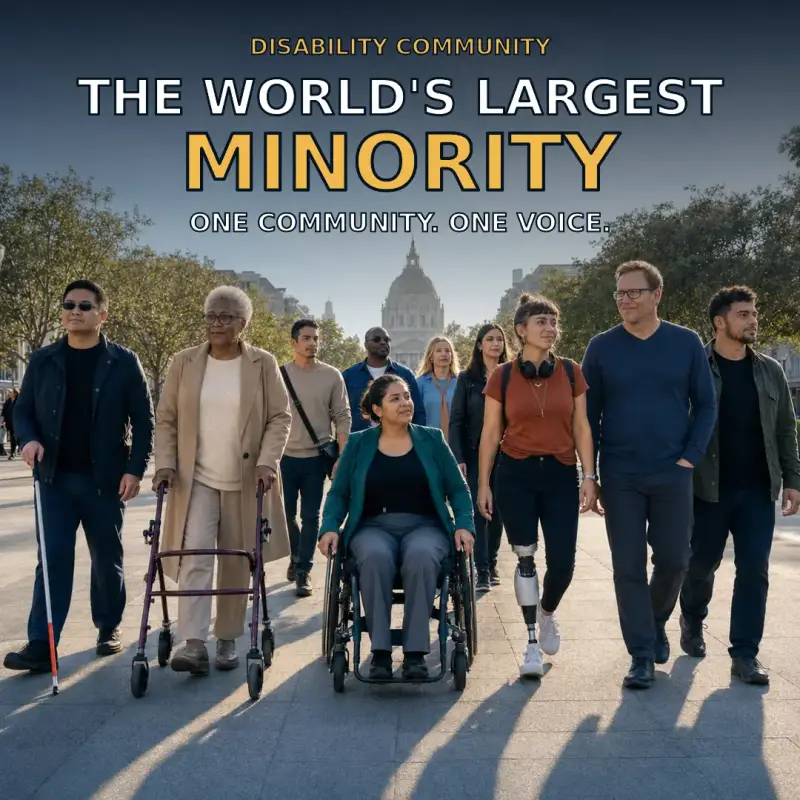
The disabled community is not a small special-interest group asking society for favors. We are the world’s largest minority.
Approximately 1.3 billion people, or one in every six people worldwide, live with a significant disability. In the United States, more than one in four adults has some form of disability. Those numbers do not include every caregiver, family member, friend, veteran, senior or temporarily injured person who also depends on accessible systems.
We are not on the edge of society. We are society.
Yet we continue to be divided by diagnoses, organizations, political parties and benefit programs. People with physical disabilities fight one battle. People with intellectual and developmental disabilities fight another. Veterans, seniors, people with invisible disabilities, people with chronic illnesses and people facing mental health conditions are placed into separate rooms, even though we are often fighting the same bureaucracy.
That separation weakens us.
If we rallied together as one community, we could become one of the most powerful political and social forces in the world. We could change laws, improve healthcare, make our streets safer and cut through the ridiculous red tape that harms everyone.
Accessible streets do not only help wheelchair users. Safer intersections, longer crossing times, visible crosswalks, working sidewalks, audible signals and better lighting also protect children, parents with strollers, injured workers and older adults.
Simplified healthcare does not only help disabled patients. Fewer forms, coordinated medical records, understandable insurance policies and faster approvals would help every person who has ever been sick, injured or responsible for a loved one.
Cutting bureaucratic red tape does not mean removing responsible oversight. It means eliminating duplicate applications, endless assessments and systems that force people to repeatedly prove conditions that are permanent. It means creating government services that ordinary people can actually understand and use.
The disability community knows where these systems fail because we are the ones forced to navigate them every day.
We know what happens when an insurance company delays treatment.
We know what happens when a sidewalk suddenly ends.
We know what happens when public transportation is inaccessible.
We know what happens when a person must complete 40 pages of paperwork while sick, injured or cognitively overwhelmed.
We know what happens when lawmakers design programs without including the people who depend on them.
The public often does not understand these failures because many people have never been forced to experience them. In that sense, our role can sometimes resemble that of a parent teaching a child about dangers the child cannot yet recognize. A parent does not explain street safety because the child is worthless or incapable. The parent explains it because experience has taught the parent what can happen.
Our community carries that experience.
We must educate the public, businesses and lawmakers, not because we believe we are superior, but because we have already lived through the consequences of their ignorance. We have seen where the dangers are. We know which systems are broken. We understand what must change.
The currently able-bodied population must also recognize a basic truth: disability is not a distant world belonging to somebody else. Disability can enter anyone’s life through an accident, illness, aging, military service, genetics or a single unexpected diagnosis.
We are the future of many people who currently consider themselves able-bodied.
That should not be viewed as a threat. It should be understood as an invitation to build a society capable of supporting every stage of human life.
We cannot wait until politicians decide we matter. We cannot continue allowing organizations to compete for attention while the larger community remains divided. We need people with visible and invisible disabilities, families, caregivers, advocates, medical professionals and responsible businesses standing together behind a shared agenda.
We need safer streets.
We need accessible and affordable healthcare.
We need employment without benefit cliffs.
We need housing that people can enter and afford.
We need technology designed for everyone.
We need government programs written in plain language.
We need disabled people included wherever policies affecting our lives are written.
Most importantly, we need to stop asking for permission to participate in decisions that directly affect us.
Our community has the numbers. We have the experience. We have the intelligence, leadership and purchasing power. What we have not consistently had is unity.
It is time to change that.
When the disability community organizes as one, we will not only improve life for disabled people. We will create a safer, more functional and more humane society for everyone.
We are not asking the world to rescue us.
We are telling the world that we are ready to help lead it.
Sources: World Health Organization, United Nations, Centers for Disease Control and Prevention
Add comment
Comments